
A New Reality: Drones as a Systemic Threat
Over the past three to five years, unmanned aerial vehicles have evolved from auxiliary tools into one of the most significant security risk factors. Where the primary threat once came from commercial quadcopters weighing one to three kilograms with an operational range of two to five kilometers, today's threat landscape includes FPV drones capable of speeds up to 300 km/h, loitering munitions with ranges of tens of kilometers, and autonomous UAVs that operate independently of continuous radio communication.
An additional risk factor is the scalability of the threat: modern attack scenarios involve the simultaneous deployment of dozens of targets. Even rudimentary swarms can overwhelm systems designed to track ten to twenty objects. A single FPV drone may cost as little as $300–$800, while the potential damage from a strike on critical infrastructure can reach hundreds of thousands or millions of dollars. This creates an asymmetry in which even limited resources can produce catastrophic consequences.
Why Traditional Security Systems Are Failing
Most existing security systems were designed without accounting for low-flying, small-sized targets. Video surveillance cameras have a limited detection range for small objects — typically no more than 200–300 meters for drones under 30–40 centimeters in size. At an FPV drone speed of 100 km/h, the available response window is under ten seconds, which effectively rules out any meaningful defensive action.
Perimeter control systems are oriented towards ground-based threats and provide no coverage of airspace. Even when thermal imagers are present, the probability of early detection remains low due to the minimal thermal signature and high speed of the target.
Standalone jammers also carry serious limitations. Typical portable systems operate at ranges of 500–1,500 meters, while stationary units extend to five to ten kilometers — but both require prior target detection. Their effectiveness is further reduced against drones employing frequency hopping, alternative navigation, or autonomous flight modes.
As a result, classical security architecture remains reactive and fails to deliver the level of proactive protection that modern threats demand.
The Evolution of Threats: From Radio-Controlled Drones to Autonomous Systems
Modern UAVs employ multi-channel architectures that integrate radio control, video links, and navigation. A typical drone may simultaneously operate across the 2.4 GHz and 5.8 GHz bands, transmit FPV video with latency below 50 milliseconds, and receive GNSS positioning data accurate to one to three meters.
Inertial navigation systems and pre-programmed flight routes provide an additional layer of resilience, allowing the drone to maintain its trajectory even under complete communication blackout. This means that suppressing a single channel degrades drone performance but does not guarantee neutralization.
Under these conditions, it becomes clear that effective protection must act across multiple layers simultaneously: command and control, navigation, and physical presence in the airspace.
The Technological Response: Multi-Layer C-UAS Architecture
Modern counter-UAV systems are built on the integration of multiple technologies, each addressing a distinct threat layer. Radio frequency detection enables the identification of drone and operator activity at ranges of three to eight kilometers, depending on signal strength and environmental conditions. Electronic jamming blocks command and data transmission channels; transmitter power in stationary systems can reach 20–60 watts and above, enabling effective suppression at significant distances.
Navigational countermeasures via GNSS spoofing or jamming operate across the L1 and L2 bands (approximately 1.2–1.5 GHz), enabling disruption of GNSS positioning accurate to one to three meters, a precision that autonomous UAVs depend on critically. Radar provides detection of small targets with a radar cross-section below 0.01 m² at ranges of several kilometers, while electro-optical systems enable visual confirmation and continuous tracking.
A centralized command-and-control system fuses all sensor data into a unified operational picture, enabling simultaneous processing of dozens of targets and decision-making within fractions of a second.

EAS DOME as an Integrated Counter-UAV Platform
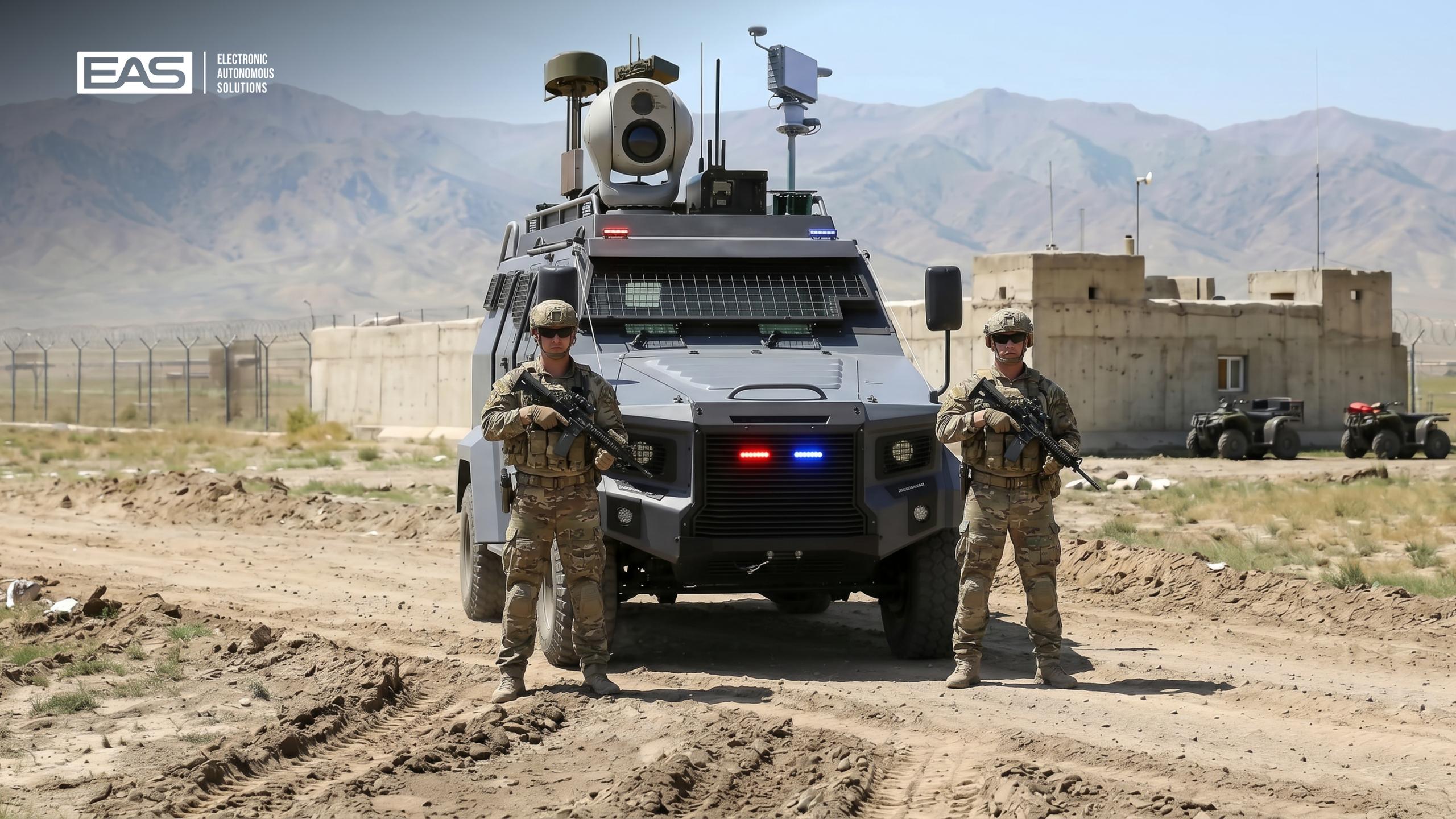
EAS DOME implements the full counter-UAV cycle within a single integrated platform, combining detection, classification, tracking, and neutralization. The system integrates wideband RF scanning, electronic warfare modules, GNSS disruption capabilities, radar sensors, electro-optical systems, and a centralized C2 management layer.
The system's operational characteristics enable target detection at ranges exceeding five kilometers, with potential extension to seven to ten kilometers in open terrain. Full 360-degree coverage and simultaneous multi-target tracking are supported throughout. System response time is measured in seconds — a critical parameter when operating against high-speed FPV drones.
This architecture allows threats to be identified before they enter the protected zone, attack vectors to be determined, signal sources to be localized, and the optimal countermeasure scenario — including radio channel or navigation suppression — to be selected automatically.
Why Layered Defense Is a Critical Necessity
A multi-layer protection architecture distributes tasks across system components and increases overall effectiveness. At extended ranges, detection occurs at distances of several kilometers, providing an additional response window of thirty seconds to several minutes depending on target speed. At the intermediate layer, classification and tracking take place, while the close-in layer delivers direct engagement using electronic and navigational countermeasures.
This approach increases intercept probability, reduces the load on individual system components, and minimizes interference with friendly communication channels. Even a marginal improvement in intercept effectiveness of 20–30% can prove decisive during mass attack scenarios.
Practical Application Scenarios
In the military domain, counter-UAV systems protect positions, bases, and military assets, providing airspace control within a radius of several kilometers and the ability to engage multiple simultaneous targets. In the critical infrastructure sector, such solutions prevent sabotage and ensure continuity of operations - where even a brief disruption can result in losses of hundreds of thousands of dollars.
In the transport sector, systems are deployed to protect airports and logistics hubs, where flight delays or operational shutdowns can cost millions. Along borders and in control zones, they enable detection and interdiction of malicious activity at distances of several kilometers. At mass public events, these systems protect thousands of people by minimizing the risk of drones being used as attack vectors.
The Economics of Security: Threat Asymmetry
Contemporary UAV threats are characterized by extreme asymmetry. Relatively inexpensive devices costing under $1,000 can inflict damage hundreds or thousands of times their own value. The use of fragmented, standalone solutions increases response time and reduces intercept probability - ultimately driving risk higher.
Integrated systems enable process automation, reduce the operational burden on personnel, and improve the overall effectiveness of protection. Even where upfront capital expenditure is higher, such solutions deliver lower total cost of ownership through reduced operating costs and prevention of potential losses.
Conclusion
The continued advancement of unmanned technologies is driving a constant escalation in threat complexity - encompassing autonomous systems, drone swarms, and hardened communication channels. In this environment, relying on individual protective measures is no longer sufficient.
Modern security requirements demand a transition to systemic solutions that unite diverse technologies within a single unified architecture. EAS DOME delivers precisely this - providing early detection, adaptive response, and sustained protection across a wide range of operational scenarios.
UAV defense today is not a matter of optimization. It is a fundamental requirement for security.