
Counter-drone technology overview
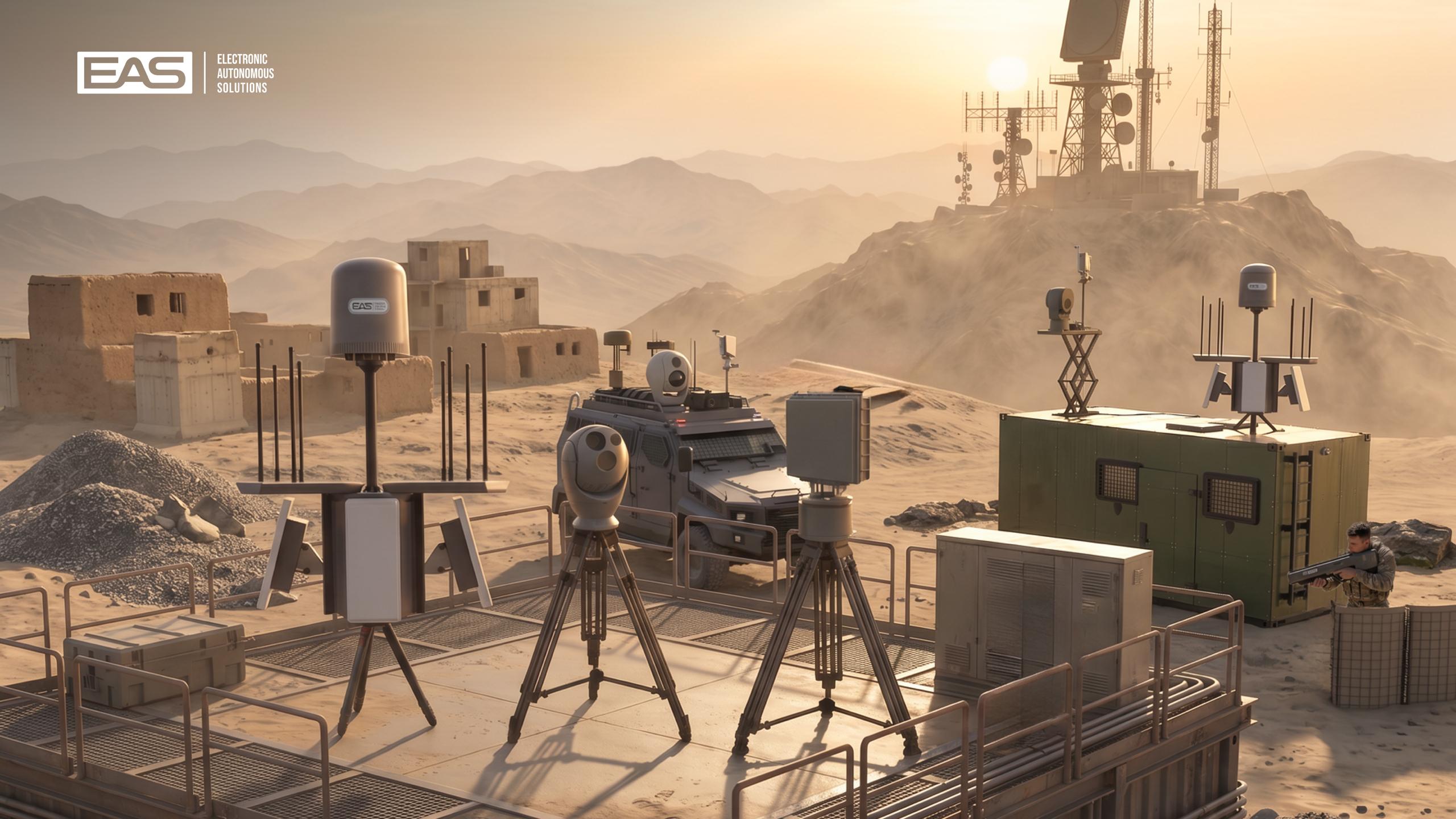
Six different technology classes are used to detect UAVs: RF sensors (radio frequency detection), radar systems, electro-optical cameras (EO), infrared and thermal imaging sensors (IR), acoustic sensors, and multisensor (hybrid) platforms. Each method operates on a distinct physical principle: RF sensors intercept drone control signals and telemetry; radars track reflected radio waves to determine range and flight path; EO cameras visually identify targets; IR sensors detect engine heat signatures; and acoustic systems recognize the characteristic sound of spinning rotors. In practice, no single technology delivers 100% reliability on its own, which is why modern C-UAS platforms — such as EAS DOME — combine multiple sensors into a unified threat-detection and identification system. AI-driven analytics, GNSS monitoring, and electronic warfare (EW) subsystems further enable layered airspace security, providing comprehensive protection against unauthorized UAVs across a wide range of operational environments.
1. RF sensors – radio frequency drone detection
RF detection – RF detection is the most widely deployed method for passive airspace monitoring. An RF sensor continuously scans the radio-frequency spectrum and compares detected signals against a database of known UAV radio signatures. When a drone communicates with its ground control station or transmits telemetry data, the system registers the aircraft's presence, classifies its type, and — in many configurations — locates the operator. This technique is especially effective for identifying commercially available drones that rely on standard radio protocols, making it a foundational layer in counter-UAS deployments at airports, government facilities, and military installations.
Advantages of RF sensors
- Passive operation — the system emits no signals of its own and cannot be detected by the threat
- Extended detection range, reaching several kilometres depending on the drone's transmitter output
- UAV type and model identification based on radio-frequency signatures
- Effective in low-visibility conditions: fog, darkness, precipitation
Limitations of RF sensors
- Ineffective against autonomous UAVs that operate without a radio link
- Degraded performance in dense urban radio environments with high levels of interference
- Cannot provide precise three-dimensional target coordinates without supplementary sensors
Applications
RF sensors are deployed to secure airports, government buildings, military bases, and restricted-access zones. They are particularly valued wherever covert surveillance is required — the system's passive nature means the security infrastructure remains undetected by hostile operators.
EAS Company product: AetherScan — a passive broadband RF sensor with an extensive UAV radio-signature database. It provides detection and preliminary threat classification with zero RF emissions of its own.
2. Radar systems for UAV detection
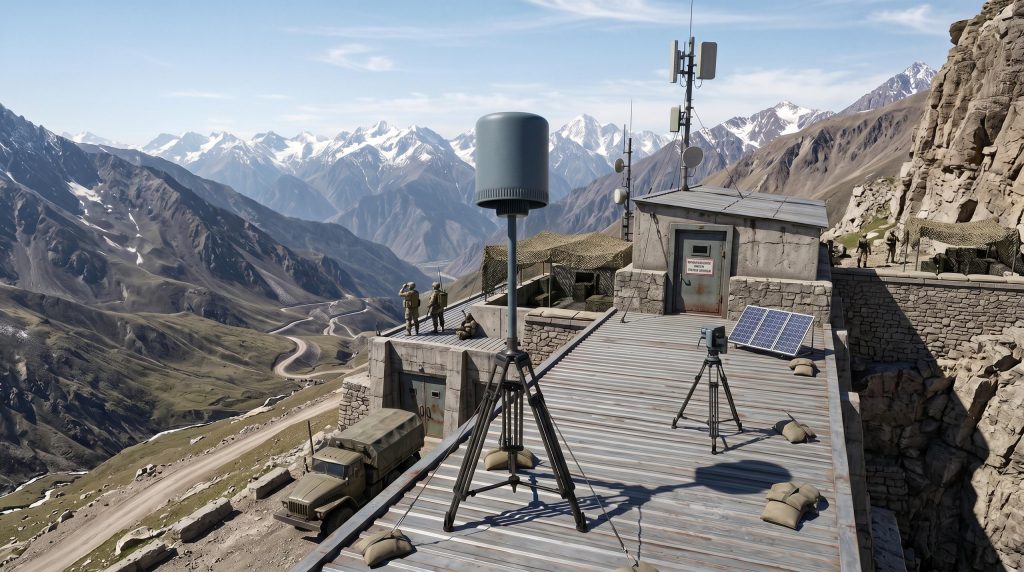
Radar is the classic active tool for airspace surveillance, now adapted to track small, low-flying targets. Modern drone-detection radars operate in the millimetre or centimetre wavelength bands, enabling them to acquire objects with a radar cross-section (RCS) of less than 0.01 m². The radar continuously transmits radio waves, receives the reflected returns, and calculates the target's range, azimuth, altitude, and velocity. Unlike passive sensors, radar delivers precise three-dimensional tracking data in real time, making it the primary detection layer in most large-scale C-UAS deployments.
Advantages
- All-weather capability — operates effectively in rain, fog, snow, and complete darkness
- Three-dimensional tracking — precise target coordinates and flight trajectory in real time
- Extended detection range — from 1 to over 7 km depending on system type
- Radio-independent detection — acquires autonomous drones that emit no signals
Limitations
- Active emissions — the radar itself can be located by adversaries
- Elevated false alarm rates in urban environments due to birds and vehicle traffic
- High acquisition cost and operational complexity
Applications
Radar systems are the standard detection tool at airports, military installations, and critical infrastructure sites. Within multisensor platforms, the radar functions as the primary detection and cueing layer, passing target data to electro-optical and RF channels for identification.
EAS Company products: the radar channel is an integral component of both EAS DOME and EAS DOME Stationary, providing primary target acquisition and handing off tracking data to the optical and RF modules for classification and identification.
3. Electro-optical systems (EO cameras) for UAV detection
Electro-optical (EO) systems are high-resolution video cameras, typically fitted with powerful variable-focal-length optics. Beyond simply registering an object's presence, visual detection allows operators to identify the UAV's type and configuration, and — critically — to build an evidential record through continuous video capture. EO cameras operate in the visible light spectrum and perform best in daylight under clear conditions. When paired with a radar or RF sensor that supplies cueing data, EO systems become a precise identification tool at extended ranges.
Advantages
- Visual identification — enables recognition of UAV type and airframe configuration
- Incident documentation — continuous video recording for post-event analysis and legal proceedings
- Passive operation — no electromagnetic emissions
- AI integration — supports automatic object recognition and classification
Limitations
- Severely degraded performance at night, in fog, or during precipitation
- Limited detection range against small aerial targets
- Requires manual operator tracking or integration with a radar or RF sensor for automated cueing
Applications
EO cameras are deployed at locations where visual confirmation of a threat is operationally or legally required: airports, embassies, government buildings, and major public events. They are most effective when combined with an RF sensor or radar that provides the initial target cue.
EAS Company products: the EO channel is an integral component of EAS DOME and EAS DOME Stationary, providing optical identification after a target has been acquired by the radar or RF sensor.
4. Thermal and infrared (IR) systems for UAV detection
Infrared (IR) sensors detect the heat emitted by UAV components — motors, batteries, and electronics. Unlike EO cameras, thermal imagers operate around the clock and remain effective in complete darkness. The thermal contrast between the drone's airframe and the surrounding air allows the system to acquire a target even when visual observation is entirely impossible. IR sensors complement EO cameras in any platform that must maintain continuous, 24/7 coverage.
Advantages
- Round-the-clock operation — entirely independent of ambient light levels
- Detection through light fog and smoke
- Passive method — no system emissions
- High sensitivity to motor and battery heat signatures
Limitations
- Reduced effectiveness against low-power electric UAVs with minimal thermal output
- Degraded accuracy in hot ambient conditions where background thermal clutter is elevated
- Cannot provide visual identification without a paired EO channel
Applications
IR sensors are primarily used for nighttime perimeter security, border surveillance, and the protection of military installations. They serve as an essential complement to EO channels in systems designed for continuous, all-hours operations.
EAS Company products: the EO/IR channel within EAS DOME delivers simultaneous optical and thermal tracking, ensuring reliable threat identification regardless of time of day or lighting conditions.
5. Acoustic sensors for UAV detection
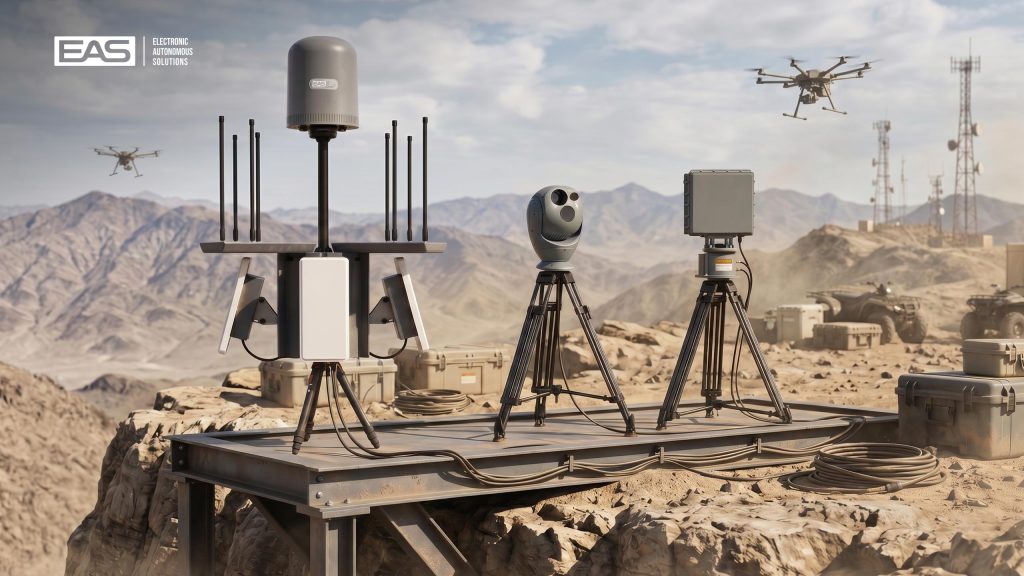
Acoustic detection systems capture the characteristic sounds produced by drone propellers and electric motors. Each UAV type generates a unique acoustic signature, which is compared in real time against a library of reference sound profiles. A microphone array can not only detect the noise source but also determine its location through acoustic triangulation. Acoustic sensors represent a low-cost passive option that can operate in conditions where radio and optical methods face limitations.
Advantages
- Passive method — emits nothing and cannot be detected
- Effective in conditions of limited visibility
- Relatively low equipment cost
- Capable of operating indoors and in enclosed spaces
Limitations
- Substantially reduced range in high-noise environments: urban areas, wind
- Limited detection range — typically 200–500 metres
- Ineffective against silent or near-silent UAVs with low acoustic output
- High false alarm rates from birds and vehicle noise
Applications
Acoustic sensors are used primarily as a component of multisensor security systems rather than as standalone solutions. They are best suited to low-noise environments: rural estates, small airfields, and prison perimeters.
6. Multisensor and hybrid UAV detection platforms
The multisensor approach combines several detection technologies into a single, centrally managed hardware-software system. Data streams from the RF sensor, radar, EO/IR cameras, and acoustic arrays flow into a common processing core that correlates signals, filters false alarms, and builds a unified, real-time air-situation picture. This fusion architecture eliminates the individual blind spots of each detection method and significantly increases overall detection confidence, enabling reliable identification of threats across a far wider range of operational scenarios than any single sensor could cover. Among all available techniques, sensor fusion delivers the most consistent results in complex, real-world environments.
Advantages
- Maximum reliability — cross-confirmation of detections from multiple independent sensors
- Resilience to countermeasures — loss of one channel does not degrade overall system performance
- Single operator interface with a complete, unified threat picture
- Integration capability with neutralisation subsystems: EW/RF jamming, interceptors
Limitations
- High acquisition cost and complex deployment
- Requires qualified technical personnel for operation and maintenance
- Larger size and weight in mobile configurations
Applications
Hybrid platforms are the standard protection solution for critical infrastructure: nuclear power plants, airports, oil and gas terminals, military bases, and national borders. They are also deployed to secure major public events and diplomatic sites.
EAS Company products: EAS DOME — the flagship multisensor platform, integrating radar, RF sensor, EO/IR cameras, and an EW subsystem into a unified C-UAS complex. EAS DOME Stationary — the fixed-installation variant designed for permanent site protection.
7. AI and machine learning in UAV detection systems
Artificial intelligence (AI) and machine learning algorithms are fundamentally transforming the detection process. Instead of relying on fixed threshold-based detectors, these advanced systems are trained on thousands of signal and imagery examples, building probabilistic threat classification models. AI analytics are applied to data from all sensor types — RF, radar, EO/IR, and acoustic — and enable the system to automatically distinguish UAVs from birds, aircraft, and other objects, reducing false alarms to a minimum. Machine learning also allows the system to improve continuously as it accumulates new field data.
Advantages
- Automatic classification and threat-type identification
- Continuous learning — the system becomes more accurate as operational data accumulates
- Real-time data processing with no operator intervention required
- Reduced operator workload and elimination of human error
Limitations
- System performance depends directly on the volume and quality of training data
- Vulnerability to adversarial attacks designed to fool classifiers
- High computational resource requirements
Applications
AI modules are embedded in all modern C-UAS systems to automate threat analysis, prioritise targets, and support operator decision-making. They are especially critical when monitoring large perimeters where continuous manual surveillance is operationally impractical.
EAS Company products: machine learning algorithms are integrated into the EAS DOME processing unit for automatic threat classification and operator recommendations.
8. GNSS monitoring and geofencing
GNSS monitoring allows security teams to track the positioning signals used by UAVs for navigation. Geofencing is a technology embedded by manufacturers in many commercial drones, using software to restrict flights in prohibited areas such as airports and government facilities. In parallel, systems have been developed that actively detect GNSS signals emitted by drones, as well as GNSS spoofing technology — which overrides the drone's navigation signal to force a change in its flight path. Both approaches offer distinct advantages depending on the threat profile and the legal framework governing use.
Advantages
- Preventive control — law-abiding drones cannot enter restricted zones
- Passive GNSS signal monitoring without additional hardware
- GNSS spoofing enables interception of a drone's navigation, allowing controlled redirection
Limitations
- Ineffective against modified or home-built UAVs that lack geofencing restrictions
- GNSS spoofing can interfere with civil aviation and other navigation-dependent systems
- Requires continuous updates to geofence databases
Applications
Geofencing is implemented by manufacturers as a built-in compliance tool. GNSS signal monitoring is used by security services and airport security teams. GNSS spoofing is a dual-use technology, permissible only in strictly regulated operational contexts.
9. Electronic warfare (EW) systems – RF jamming
Electronic warfare (EW) is an active neutralisation method that disrupts UAV control channels, video links, and navigation by generating targeted RF interference on the drone's operating frequencies — 2.4 GHz, 5.8 GHz, and GNSS bands — severing the aircraft's connection with the operator and its navigation signal. Most commercial UAVs are programmed to return to their launch point or land safely upon losing signal contact, allowing incidents to be concluded in a controlled manner without physical destruction of the airframe.
Advantages
- Immediate threat suppression without physically destroying the drone
- Selective frequency targeting — minimal impact on legitimate radio signals
- Portable options available for rapid-response deployment
- Integration into fixed installations for automated, autonomous jamming
Limitations
- Legal restrictions — EW deployment in civilian environments requires specific authorization
- Risk of interference with legitimate communications and aviation if improperly applied
- Ineffective against fully autonomous UAVs operating without a radio link
Applications
EW systems are deployed by military units, law enforcement agencies, and critical infrastructure operators. Fixed jammers are integrated into perimeter protection systems; mobile units are used for rapid-response operations.
EAS Company products: EAS AirGuard — a combined detection and RF jamming system. EAS FOWLER — a portable jammer for individual operator use. EAS AIR SHIELD-1MS — a mobile platform providing UAV detection, radio direction-finding, and RF jamming of small aerial targets. All three products meet regulatory requirements for selective frequency interference.
10. Integrated C-UAS platforms – comprehensive airspace protection
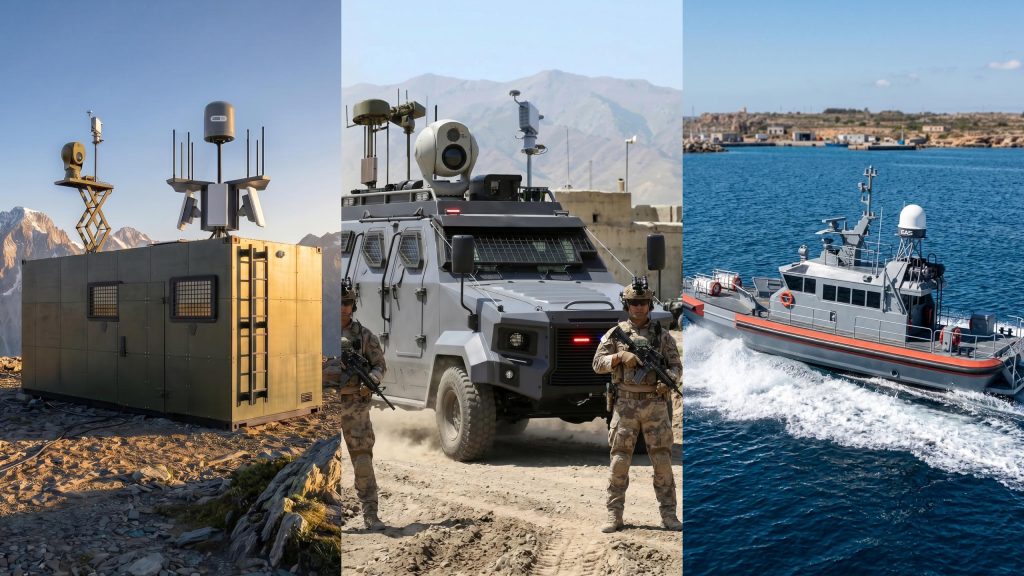
Comprehensive counter-UAS (C-UAS) platforms consolidate all of the technologies described above — detection, identification, tracking, and neutralisation — into a single, centrally managed system with a unified command post. Designed to address the full spectrum of UAS threats, each platform covers the complete threat-response cycle: from initial detection through to neutralisation, with full incident documentation and the capability to transmit operational data to higher-level command systems. These platforms represent the highest tier of airspace security, designed for environments where partial coverage is not an option.
Advantages
- Layered defence — multiple independent detection and neutralisation tiers
- Single operational picture for real-time command decisions
- Scalability — from single-site protection to regional airspace security against small UAVs and drones
- Interoperability with existing command, control, and communications systems
Limitations
- Highest acquisition cost among all C-UAS solutions
- Demanding infrastructure and personnel training requirements
- Complex integration procedure with existing site security systems
Applications
C-UAS platforms are the solution of choice for airports, military installations, energy facilities, oil and gas terminals, national borders, and critical diplomatic sites. They are also deployed for temporary protection at large-scale state-level events.
EAS Company products: the full EAS Company product line forms a comprehensive airspace protection ecosystem. EAS DOME and EAS DOME Stationary serve as the system core. The AIR SHIELD series covers mobile anti-drone operations. The EAS ADE AIRWALL series addresses fixed-installation counter-drone requirements. AirGuard provides active threat suppression at close and medium range. FOWLER delivers tactical-level portable jamming for field teams.
Conclusion
Drone detection technologies are evolving in step with the UAVs they are designed to counter: every new class of unmanned aerial system creates new challenges for security developers. RF sensors, radars, EO/IR sensors, acoustic systems, AI analytics, GNSS monitoring, and electronic warfare — each tool addresses a specific segment of the threat spectrum and forms a distinct layer of the overall defense architecture. The optimal protection strategy for any site or airspace is always built on a careful analysis of the specific threats present, local terrain conditions, and applicable regulatory requirements, followed by the selection of the most effective combination of technologies. This principle is the foundation of EAS Company's product philosophy: modular, scalable C-UAS platforms adaptable to the operational requirements of any customer.
FAQ — frequently asked questions about drone detection technologies
Which drone detection technology is the most reliable?
No single technology delivers 100% detection reliability. Every method has its limitations: RF sensors cannot detect autonomous drones, radars generate elevated false alarm rates in urban environments, and EO cameras are ineffective at night. The most dependable solution remains a multisensor C-UAS platform, where data from multiple sensors cross-confirm one another and compensate for each other's blind spots.
How do you detect a drone that isn't transmitting?
Autonomous UAVs that operate without a radio control link cannot be acquired by RF detection. In these scenarios, active methods come into play: radar tracks the target by its reflected signal regardless of whether any radio communications are present; EO/IR cameras identify the object visually and by its heat signature; and acoustic sensors respond to the characteristic sound of the rotors. Integrated C-UAS platforms are specifically designed for these scenarios, combining multiple independent detection channels to ensure no threat goes undetected.
Is it possible to detect a drone in an urban environment?
Urban environments create significant interference for all sensor types: high radio noise for RF detectors, multiple reflective surfaces for radars, elevated thermal clutter for IR sensors, and constant background noise for acoustic systems. Despite these challenges, modern AI algorithms substantially reduce false alarm rates and improve identification accuracy in complex conditions. Purpose-built small-target radars and wideband RF sensors are specifically adapted for operation in radio-dense urban settings.
What is the difference between drone detection systems and counter-drone systems?
Detection systems identify and register the presence of a UAV in monitored airspace — this category includes RF sensors, radars, EO/IR cameras, and acoustic systems. Counter-drone systems neutralise the threat: EW subsystems suppress communication and navigation links, while kinetic interceptors physically destroy the target. A complete C-UAS platform combines both components: the detection layer passes target data directly to the neutralisation subsystem, creating a closed-loop threat-response cycle.
What drone detection technologies are used at airports?
Airports typically deploy multi-layered C-UAS systems: small-target radars provide primary detection at long range, RF sensors identify the UAV type and locate the operator, EO/IR cameras supply visual confirmation, and EW systems stand ready for immediate threat suppression. All components are integrated into a single command centre with round-the-clock operator coverage. A number of airports also employ GNSS monitoring to track compliance with established geofencing boundaries.